


EUROPAN17
How to educate a new generation of citizens through liveable and biodiverse public spaces? How to stress the idea of biodiversity and coliving of people and nature? How to re-use existing buildings and to create new ones for a biodiverse city?
Silvia Lanteri, Maicol Negrello, Filippo Fiandanese (project lead) Simona Pecoraro, Giorgia Somale, Leonardo Properzi (team)
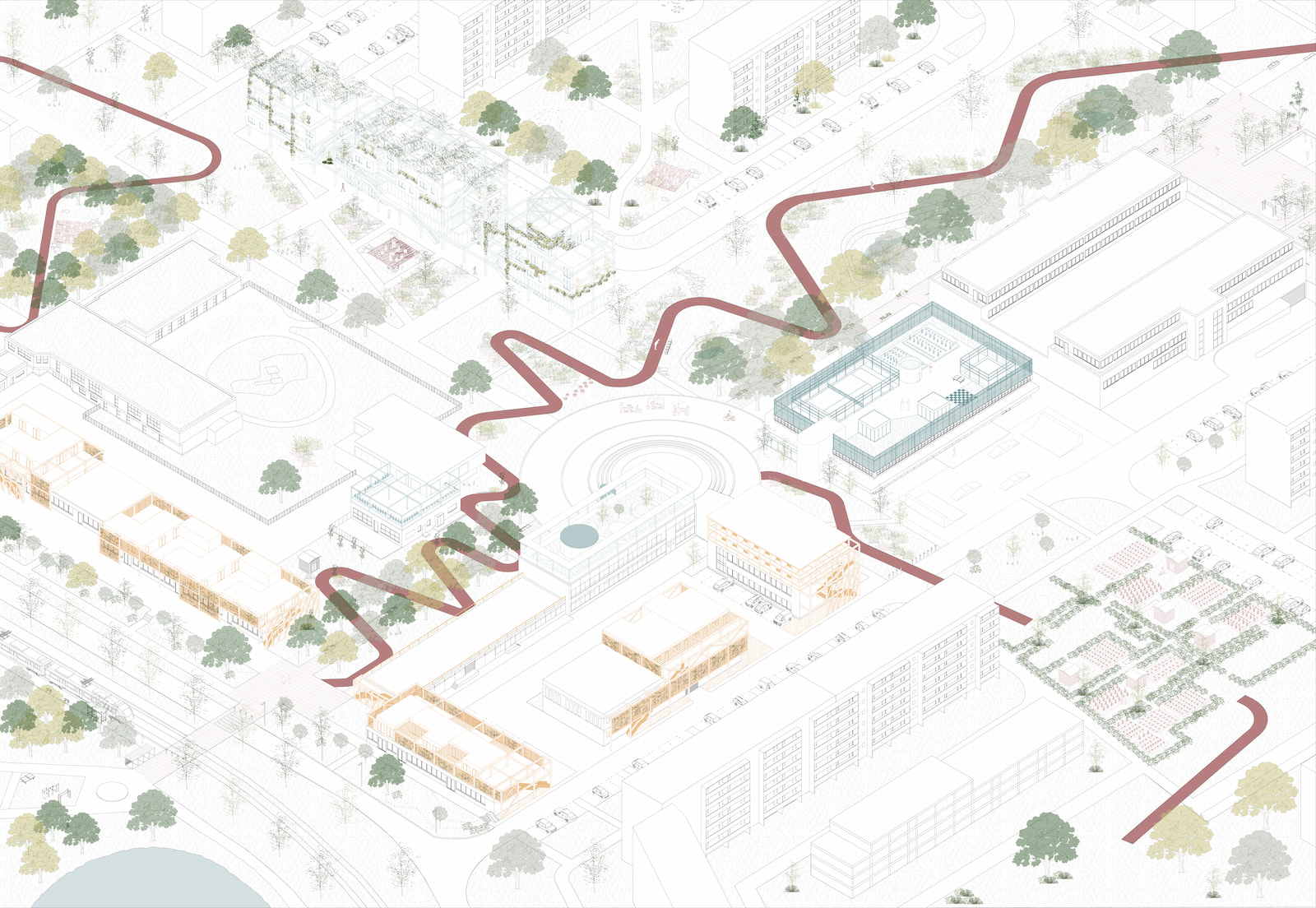
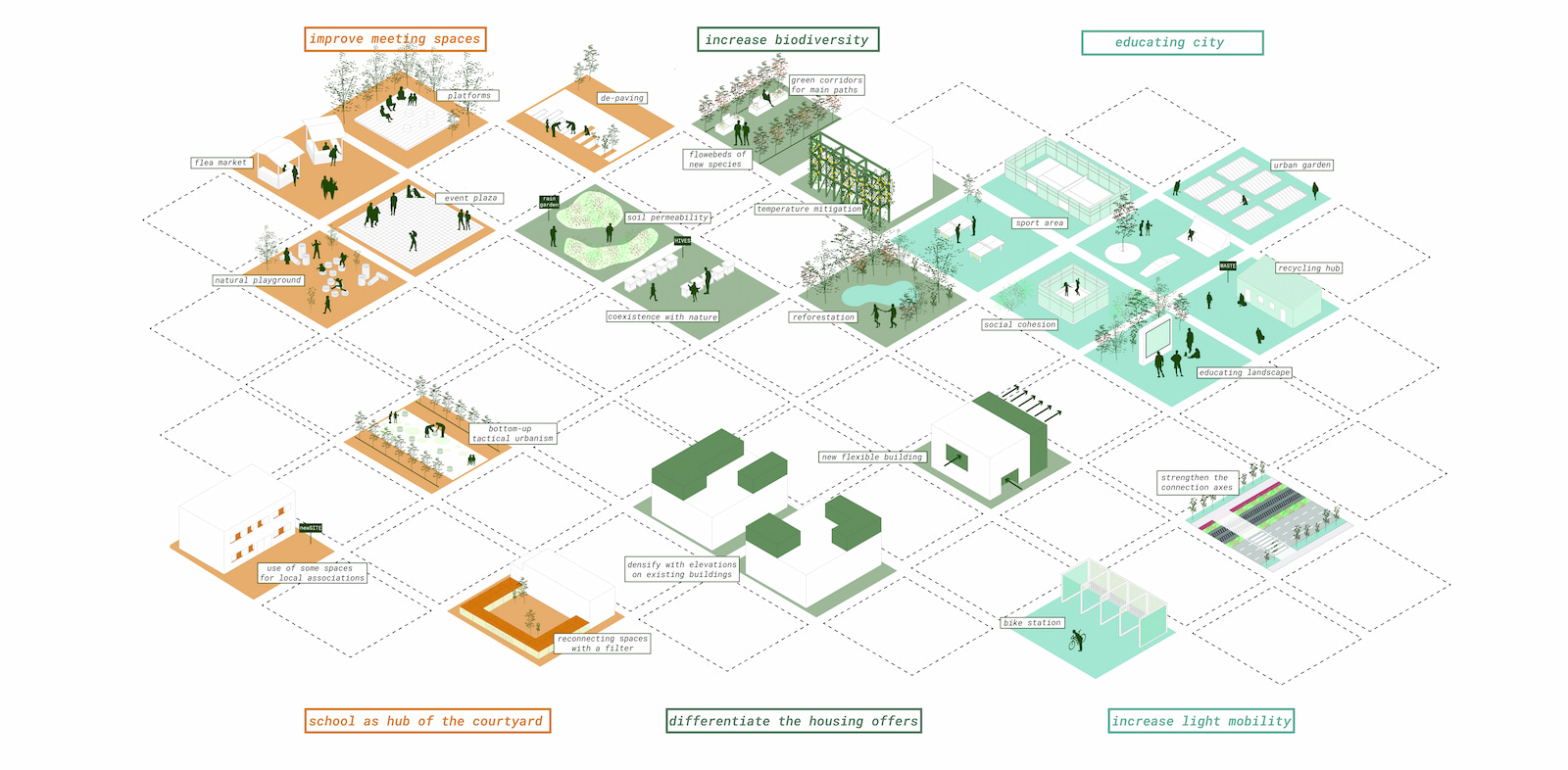
The “Learning from Common Ground” project reimagines the Grünau district as an ecological transition from a car-oriented, socially engineered model to an inclusive, environment-centered landscape. It shifts the focus from a human-centered city to a system where relationships between humans, non-humans, and nature shape urban development. The masterplan is structured as a network of interconnected commons, conceived as a soft infrastructure of care that transforms Grünau into an educational landscape. Public space, landscape, and architecture foster ecological awareness and social resilience. A continuous green corridor links schools, parks, civic facilities, and sports areas within a 15-minute network for people and non-human species, enhancing biodiversity and connectivity. At the architectural scale, a linear axis between the new school and the commercial area becomes a sequence of urban rooms and learning spaces, extending education into the city. Existing infrastructures are progressively depaved and renaturalized, enabling soil regeneration and biodiversity growth. The transformation is incremental: initial phases activate the commons through temporary uses and community-driven initiatives, followed by soil reconfiguration, refurbishment of existing buildings such as the former Konsum, and new mixed-use constructions. In the long term, densification extends to rooftops and façades, integrating vegetation and new spatial layers. Buildings are reimagined as hybrid ecological infrastructures hosting both human and non-human life. The former Konsum becomes a civic hub with community and cultural functions. Overall, the project envisions Grünau as an evolving ecological district where architecture, landscape, and infrastructure merge into a continuous system of care, education, and biodiversity.

